

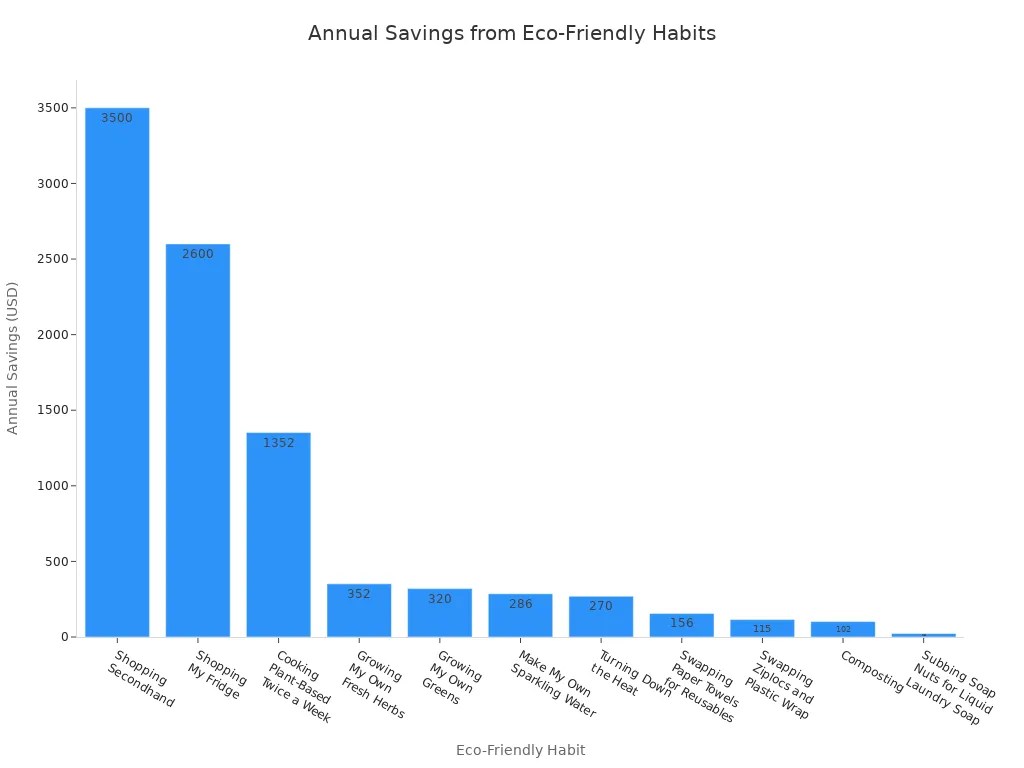
You might be surprised by how much you can help your wallet and the planet with small changes. When you pick Eco-Friendly Habits, you save money. You also send less trash to the landfill. Look at the table below. Simple changes like shopping secondhand or lowering the heat can save you a lot of money each year.
| Eco-Friendly Habit | Total Annual Savings |
|---|---|
| Shopping Secondhand | $3,500 |
| Shopping My Fridge | $2,600 |
| Cooking Plant-Based Twice a Week | $1,352 |
| Growing My Own Fresh Herbs | $352 |
| Growing My Own Greens | $320 |
| Make My Own Sparkling Water | $286 |
| Turning Down the Heat | $270 |
| Swapping Paper Towels for Reusables | $156 |
| Swapping Ziplocs and Plastic Wrap for Reusable Storage | $115 |
| Composting | $102 |
| Subbing Soap Nuts for Liquid Laundry Soap | $23 |
Try one small change this week. You may find it is easy to do!
Key Takeaways
- Using eco-friendly habits can help you save a lot of money. For example, buying secondhand things can save you up to $3,500 each year.
- Cutting down on single-use items, like plastic bags and straws, helps lower waste. This can save a family about $1,800 every year.
- Composting and recycling help make less trash in landfills. They also save energy and make soil better. This is good for your garden and the earth.
- Using leftovers well can help you waste less food and save money. Planning meals and storing food right keeps it fresh and stops waste.
- Joining local eco-friendly groups builds community spirit and makes your actions stronger. Working together helps keep neighborhoods clean and makes the planet healthier.
Daily Eco-Friendly Habits
Reduce Single-Use Items
You see single-use items everywhere. Plastic bags, straws, and wrappers fill your trash can fast. When you refuse unnecessary packaging or choose products with recyclable wrapping paper, you cut down on waste. Try using reusable bags when you shop. Switch to stainless steel straws and cutlery. Repurpose old t-shirts into cleaning rags. These small swaps add up.
Did you know? One person shared that by cutting out waste products, they saved at least $18,000. On average, a U.S. household can save about $1,800 each year by reducing food waste. That’s money you can use for something fun or important.
Here are some easy ways to start:
- Use refillable water bottles instead of single-use ones.
- Choose reusable containers for food storage.
- Opt for products with minimal or recyclable packaging.
- Replace paper towels with washable cloths.
- Invest in compostable plates and utensils for parties.
Compost and Recycle
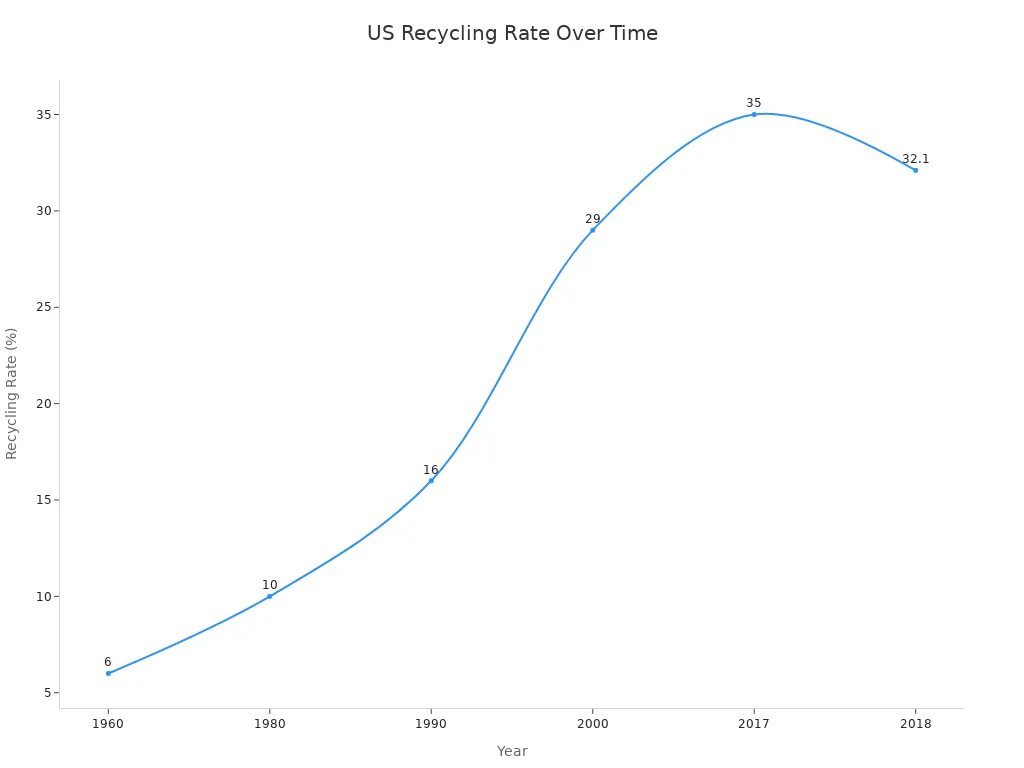
Composting and recycling keep a lot of trash out of landfills. You can compost food scraps, yard waste, and even some paper products. Recycling helps turn old bottles, cans, and paper into new things. Over the years, recycling rates have grown in the U.S.:
| Year | Recycling Rate (%) |
|---|---|
| 1960 | 6 |
| 1980 | 10 |
| 1990 | 16 |
| 2000 | 29 |
| 2017 | 35 |
| 2018 | 32.1 |
When you recycle, you save energy. For example:
| Material | Energy Savings (Equivalent) |
|---|---|
| 20 oz plastic bottle | Powers a CFL lightbulb for 10.3 hours |
| 500 sheets of printer paper | Powers a laptop for 49 hours |
| 12 oz glass bottle | Powers a CFL lightbulb for 5.3 hours |
| 1 aluminum can | Powers a laptop for 5.8 hours |
Composting does more than reduce waste. It helps fight climate change by keeping organic waste out of landfills. Composting also cuts methane emissions and makes soil healthier. When you add finished compost to your garden, you improve moisture retention and attract helpful bugs. You need fewer fertilizers and pesticides, which saves you money.
Use Leftovers
Food waste is a big problem. U.S. households throw away about 6.2 cups of food every week. That’s 322 cups a year! If you toss leftovers often, you waste three times more food than someone who uses them up. Produce is the most wasted food group, making up double the waste of prepared foods.
You can save money and reduce waste by using leftovers. Here are some tips:
- Wrap leftovers tightly or use airtight containers. Chill them quickly.
- Eat leftovers within 3-4 days or freeze them. Label with the date.
- Try the “Cook Once, Eat Twice” method. Make extra rice or pasta and use it in salads, soups, or stir-fries.
- Plan meals around foods you already have.
Meal planning helps you buy only what you need. Proper storage keeps food fresh longer. These Eco-Friendly Habits make your kitchen smarter and your wallet happier.
Reusable Bottles and Cups
Single-use bottles and cups create mountains of plastic waste. If you switch to reusable bottles, you can replace 150 to 300 single-use bottles every year. Imagine one million people doing this—hundreds of millions of bottles would never end up in the trash.
| Description | Impact |
|---|---|
| One reusable bottle | Replaces 150-300 single-use bottles per year |
| One million people using reusable bottles | Hundreds of millions of bottles avoided |
Reusable bottles and cups do more than save plastic. They lower the demand for plastic production. They inspire others to make better choices. When you refuse single-use plastics, you send a message to companies and leaders to offer better options.
- Bring your own bottle to school or work.
- Use a travel mug for coffee or tea.
- Encourage friends and family to do the same.
Every time you choose a reusable item, you help the planet and save money. These Eco-Friendly Habits are easy to start and make a big difference.
Smart Shopping

Buy in Bulk
You can save money and reduce waste when you buy in bulk. Bulk items often use less packaging, so you throw away less plastic and cardboard. You also pay less per unit, which means more savings for you. Check out the table below to see the benefits:
| Benefit Type | What You Get |
|---|---|
| Reduction in Packaging Waste | Less trash from packaging |
| Cost Savings | Lower price per unit, about 5% savings on average |
| Lower Carbon Footprint | Fewer trips and less packaging mean less pollution |
Tip: Try switching to bulk oats or rice. One shopper noticed a big drop in plastic waste just by buying oats in a large paper bag.
Thrift and Secondhand
Shopping at thrift stores or buying secondhand helps your wallet and the planet. You give items a second life and keep them out of landfills. Did you know more than half of shoppers worldwide bought a secondhand item last year? The secondhand clothing market now makes up 10% of global fashion sales. In the U.S., secondhand apparel sales grew by 14% in 2024.
- Thrift store shoppers save an average of $2,071 per year.
- You can find clothes, furniture, and even electronics at a fraction of the original price.
Next time you need something, check a thrift store first. You might find a hidden gem and save money.
Support Eco-Conscious Brands
When you shop, look for brands that care about the environment. Not all brands are the same. Some use green marketing without real action. Here’s how you can spot a true eco-conscious brand:
| Feature | Genuine Eco-Conscious Brand | Green Marketing Brand |
|---|---|---|
| Claims | Specific, data-backed, and verifiable | Vague and general |
| Transparency | Shares info about practices and supply chain | Hides details or avoids transparency |
| Certifications | Uses third-party certifications | Uses self-made or irrelevant labels |
- Look for credible certifications.
- Check if the brand shares details about its supply chain.
- See if the company thinks about the whole life of its products.
- Notice if the brand supports bigger changes for the environment.
Grow Your Own Produce
You can save even more by growing your own food. For example, growing tomatoes at home can save you $16.50 for every 15 pounds you harvest. Lettuce and raspberries also cost much less when you grow them yourself. Homegrown produce often has more vitamins because you pick it at peak ripeness. This is one of the Eco-Friendly Habits that helps your health and your budget.
Energy and Water Savings
Efficient Lighting
You can make a big difference in your home just by changing your light bulbs. LED lights use up to 75% less energythan old incandescent bulbs and last 25 times longer. Compact fluorescent lamps (CFLs) also save about 70% of energy. Smart lighting lets you control lights with your phone or set timers, so you never forget to turn them off. Solar-powered lights work great outside and cost nothing to run.
| Lighting Option | Energy Savings | Lifespan Comparison |
|---|---|---|
| LED Lights | Uses up to 75% less energy | Lasts 25 times longer |
| CFLs | Uses about 70% less energy | Shorter lifespan than LEDs |
| Smart Lighting | Saves energy through automation | Varies |
| Solar Powered Lighting | No electricity costs | Varies |
Switching to LED lighting can save you about $225 each year. If you replace just five of your most-used light fixtures with ENERGY STAR bulbs, you could save $45 every year. Each ENERGY STAR LED bulb saves about $80 over its lifetime. That’s money back in your pocket!
Save Water
Saving water at home is easier than you think. Try these simple steps:
- Upgrade faucets and showerheads to WaterSense labeled products. You can save 30% or more on water use.
- Fix leaky faucets right away. Even a small drip can waste a lot of water.
- Turn off the tap while brushing your teeth or shaving. This can save thousands of gallons each year.
- Take shorter showers. Cutting just one minute can save 550 gallons a year.
- Install water-efficient toilets. These can save nearly 13,000 gallons of water every year.
Water conservation does more than save water. It also lowers your energy bills because almost 19% of home energy goes to heating water. You could save up to $150 a year just by using less water. Plus, you help protect the environment and keep natural habitats healthy.
Green Transportation
You can help the planet and your wallet by choosing green transportation. Walking, biking, or taking public transit all cut down on pollution. Public transportation uses less energy and creates fewer greenhouse gases per person than cars. Fewer cars on the road mean cleaner air and better health for everyone.
- Public transit can save you over $9,000 a year compared to driving alone.
- Walking and biking lower your carbon footprint by up to 30%.
- Switching to a car that gets better gas mileage or using an electric vehicle can save you thousands in fuel costs and reduce emissions by tons each year.
Try biking to school, carpooling with friends, or using the bus when you can. These Eco-Friendly Habits make a real impact on your budget and the world around you.
Community and Lifestyle
Join Local Initiatives
Joining local eco-friendly groups can make a big difference. These groups plan clean-up days and recycling drives. They also hold workshops to teach new skills. When you help, others want to help too. Working together makes your community cleaner. For example, one small group cleaned a park every month. Their work made the park nicer. Other neighborhoods saw this and started their own clean-ups.
When a community works together on waste, less goes to landfills. Recycling and handling waste right helps a lot. One person can help, but many people make a bigger change.
Here are some local projects that worked well:
| Initiative | Location | Year | Community Benefits |
|---|---|---|---|
| Construction of a major sports arena | Los Angeles, CA | 2001 | Job creation, infrastructure improvements |
| Expansion of Los Angeles International Airport | Los Angeles, CA | 2005 | Job creation, environmental protections |
You can find local events or groups online. Try joining a clean-up or a recycling class. When you join in, your community gets stronger and greener.
Share and Borrow
You do not always have to buy new things. Sharing and borrowing with neighbors saves money and cuts waste. Many towns have fun ways to share stuff. You can join a SWAP Meet page online to trade or give away things. Some places have a Free Stuff Box for people to drop off or pick up items.
| Method | Description |
|---|---|
| SWAP Meet Page | A Facebook group for sharing, trading, or selling items at low cost locally. |
| Community Refrigerator Nights | Neighbors pool edible leftovers, inspired by community fridges. |
| Empty the Fridge Party | Friends share leftovers in a fun gathering, reducing food waste. |
| Free Stuff Box | A box for dropping off and picking up household items. |
| Libraries of Things | Public libraries lend tools and other items beyond books. |
- Make a SWAP Meet page for your town.
- Plan events to share food and things.
- Use your library to borrow tools and gadgets.
When you share, you help others and keep good items out of the trash.
Educate Others
You can teach friends and family about Eco-Friendly Habits. Sharing what you know helps everyone. You can plan workshops or lunch talks about recycling or saving energy. Use social media or email to send tips and stories. You can also talk about eco-friendly choices at school or work.
- Host workshops or talks about recycling and saving energy.
- Share tips on social media and by email.
- Ask others to try small changes.
- Show your care for the planet at events.
Teaching others helps more people care for the earth. Your actions can inspire others to join and make good changes.
You can see real savings and less waste when you try Eco-Friendly Habits. Even small changes help your wallet and the planet. Many simple steps pay off fast and can even boost the economy. Why not pick one or two habits to start today? Every action counts. You have the power to make a difference for your home and the world. 🌱
FAQ
What is the easiest eco-friendly habit to start with?
You can begin by using a reusable water bottle. This habit saves money and keeps hundreds of plastic bottles out of the trash each year. You just fill it up and take it everywhere.
How do I know if a brand is truly eco-friendly?
Look for clear certifications like ENERGY STAR or Fair Trade. Brands that share details about their products and supply chain usually care about the environment. You can check their website for honest information.
Can I save money by composting at home?
Yes! Composting cuts down on trash and lowers your need for store-bought fertilizers. You can use food scraps and yard waste to make rich soil for your garden. This saves you money and helps your plants grow.
What if my family isn’t interested in eco-friendly habits?
Try sharing fun facts or showing how much money you can save. You can invite them to join a local clean-up or swap event. Sometimes, small changes inspire others to get involved.